

Fluorescent test gowns play a crucial role in identifying contamination vulnerabilities in clinical settings. These gowns help you see contamination that might otherwise go unnoticed. Where do clinical studies utilizing fluorescent test gown contamination reveal the most vulnerable zones? Studies show that contamination incidents occur 46% of the time, highlighting the need for better safety measures. By using fluorescent test gowns, healthcare professionals can significantly reduce contamination risks during procedures like doffing. This understanding is vital for improving safety protocols and protecting both patients and healthcare workers.
Key Takeaways
Fluorescent test gowns help visualize contamination, revealing hidden risks in clinical settings.
Common contamination sites include the neck and hands, especially during doffing of PPE; focus on these areas to minimize risks.
Enhancing training on proper gown usage and hand hygiene can significantly reduce contamination incidents.
Implementing seamless PPE designs can lower contamination risks during removal, improving safety for healthcare workers.
Regular training and disinfection protocols are essential for maintaining a safe clinical environment.
Fluorescent Test Gowns Overview

Purpose in Clinical Studies
Fluorescent test gowns serve a vital purpose in clinical studies. They help you visualize contamination that may occur during medical procedures. By using these gowns, researchers can simulate contamination scenarios. This simulation allows you to see how easily germs can spread in a clinical environment. The insights gained from these studies are crucial for improving safety protocols.
Vulnerable Areas Identified
Clinical studies utilizing fluorescent test gowns reveal several vulnerable areas. For instance, during wound debridement procedures, fluorescent labeling mimics contamination on both the operator and the surrounding environment. The findings show that debridement can lead to contamination of the operator’s hands and work clothes. These areas are potential sources of healthcare-associated infections (HAIs).
Additionally, fluorescent powder often appears around the operating area. This indicates that the environment can become contaminated during procedures. Such observations highlight the need for proper cleaning and disinfection practices.
To compare the effectiveness of fluorescent test gowns with other contamination detection methods, consider the following table:
Method | Ease of Use | Accuracy | Feedback Type |
|---|---|---|---|
Fluorescent Markers | High | Moderate | Immediate Visual |
MS2 Bacteriophage | Low | High | Requires Laboratory Expertise |
This table shows that while fluorescent markers are easy to use, they provide moderate accuracy. In contrast, methods like MS2 bacteriophage require more expertise but offer higher accuracy. Understanding these differences helps you choose the best method for contamination detection.
Mechanism of Action
Detection Process
Fluorescent dyes play a key role in detecting contamination in clinical settings. These dyes provide rapid detection of target analytes with high selectivity and sensitivity. The detection mechanism involves several processes:
Internal Charge Transfer (ICT): This process allows the dye to respond to the presence of contaminants.
Twisted Intramolecular Charge Transfer (TICT): This mechanism enhances the sensitivity of the dye.
Aggregation-Induced Emission (AIE): This phenomenon helps in amplifying the fluorescence signal.
When you expose these dyes to light, they generate fluorescence signals. This enables real-time imaging and quantification of contaminants, making it easier for you to identify potential risks in clinical environments.
Visualizing Contamination
Using ultraviolet (UV) light significantly enhances the visibility of contamination on fluorescent test gowns. Here’s how it works:
A nontoxic fluorescent solution is applied during PPE training. This solution remains invisible under normal lighting but becomes visible under UV light.
After simulating a contamination scenario, healthcare staff can identify contamination on PPE in a dark room using a black-light flashlight. This method reveals areas of contamination that would otherwise go unnoticed.
Fluorescent powder contamination can be tracked using ultraviolet lamps in a darkened room. This technique allows you to examine contamination routes during doffing processes.
Studies show that fluorescent polystyrene latex spheres (PSLs) are more effective than traditional fluorescent tracer methods in detecting skin contamination. For example, the PSL method identified contamination in areas like hands and wrists, which had a higher contamination rate (57% vs. 23% for head/face). This indicates that fluorescent test gowns using PSLs provide a more sensitive visualization of contamination compared to traditional methods.
Where Do Clinical Studies Utilizing Fluorescent Test Gown Contamination Reveal Vulnerabilities
Study 1: Contamination in Doffing
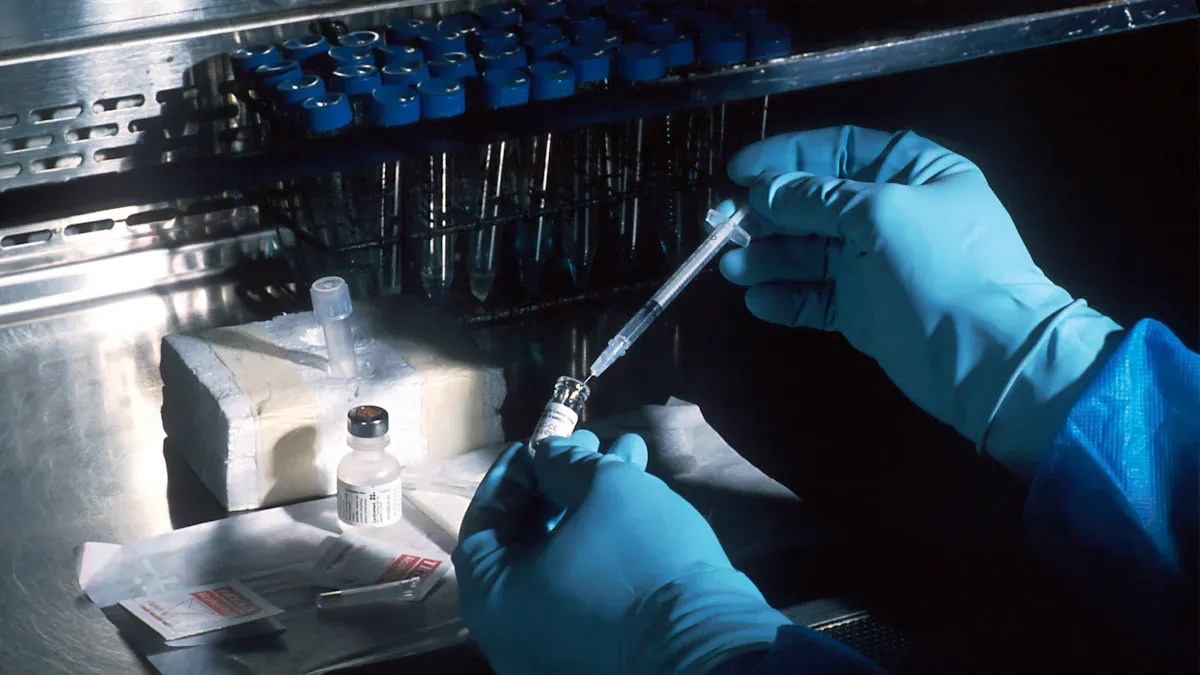
One significant study examined contamination during the doffing process of personal protective equipment (PPE). Researchers reported a total of 65 contamination incidents, averaging 2.2 incidents per healthcare worker. The most common contamination sites included the neck, foot, and head. These findings emphasize the need for enhanced training and procedural improvements to reduce contamination risks.
Key Takeaway: You must pay special attention to areas like the neck and hands during doffing to minimize self-contamination.
Study 2: Vulnerable Areas in PPE
Another study focused on identifying vulnerable areas in PPE using fluorescent test gowns. The researchers used fluorescent powder to simulate contamination on various surfaces. They found that contamination often transferred to the surgical field, highlighting significant vulnerabilities.
The table below summarizes the findings regarding the most common vulnerable areas identified in PPE:
Contamination Size | |
|---|---|
WHO N95 and coverall | Large patches (4) |
NC N95 and coverall | Large patches (2) |
CDC N95 and coverall | Small patches (1) |
Health Canada N95 and gown | Small patches (1) |
These results indicate that certain PPE designs may not provide adequate coverage, leading to contamination.
Important Note: Factors such as the availability and quality of PPE significantly influence compliance among healthcare workers.
By understanding these vulnerabilities, you can take proactive steps to improve safety protocols and reduce contamination risks in clinical settings.
Implications for Clinical Practice
Enhancing Safety Protocols
The findings from fluorescent test gown studies can significantly influence safety protocols in clinical settings. For instance, research shows that many dental health care personnel (DHCP) make errors during the donning and doffing of PPE. Specifically, 63% of DHCP committed at least one error when putting on the gown, and 60% did so when taking it off. These errors often involve improper use of gown features and difficulties in doffing without contamination.
To address these issues, you should focus on enhancing training programs. Training should emphasize proper gown usage and hand hygiene practices. By improving these areas, you can reduce contamination risks and enhance overall safety in clinical environments.
Improving Protective Measures
You can implement several strategies to prevent contamination based on evidence from fluorescent test gown studies. The table below summarizes effective strategies:
Strategy | Description |
|---|---|
Gown Removal | Quick one-step removal of a gown and gloves may reduce self-contamination in the arm/hand area. |
Comparison of PPE | Self-contamination after removing coveralls was greater than after removing gowns, indicating gowns are more effective. |
Training Importance | Repeated training sessions and enhanced knowledge on self-contamination are crucial for effective PPE use. |
Additionally, improvements in protective measures have emerged from these studies. For example, educational interventions now train personnel using fluorescent lotions to illustrate how pathogens spread during simulations. This hands-on approach helps you understand contamination routes better.
Moreover, PPE design improvements have led to the development of seamless PPE that ensures wrist coverage. This design allows for the simultaneous removal of gloves and gowns, which reduces contamination risks.
You should also consider implementing disinfection protocols that recommend disinfecting gloves during PPE doffing. This practice minimizes contamination risks and enhances safety for both healthcare workers and patients.
The integration of findings from fluorescent test gown studies has shown positive changes in clinical outcomes. For instance, a study revealed that hood PPE had a residual contamination rate of 40%, while standard PPE had a rate of 90%. This significant difference indicates that adopting better protective measures can lead to improved safety.
Fluorescent test gowns reveal critical insights into contamination vulnerabilities in clinical settings. Here are the key findings:
Key Finding | Description |
|---|---|
Visualization of Contamination | Fluorescent lotion effectively illustrated pathogen dissemination during simulated patient care interactions. |
Training Effectiveness | Educational interventions using fluorescent lotion reduced skin and clothing contamination after PPE removal. |
Need for Additional Measures | While contamination was reduced, it was not eliminated, indicating the need for further disinfection measures. |
Design Improvements | A prototype seamless PPE design showed promise in reducing contamination risk during removal. |
Integrating these findings into your clinical practice can significantly enhance infection control measures. For example, sealing the glove-gown interface (GGI) reduces particle leakage during surgical procedures. This integration minimizes contamination risks, especially in high-pressure environments. By applying these insights, you can improve safety for both patients and healthcare workers.
FAQ
What are fluorescent test gowns?
Fluorescent test gowns are specialized garments used in clinical studies. They contain fluorescent dyes that help you visualize contamination during medical procedures. These gowns simulate contamination scenarios, allowing you to identify vulnerable areas effectively.
How do fluorescent test gowns improve safety?
These gowns enhance safety by revealing contamination risks that might go unnoticed. By using them, you can better understand how germs spread and implement improved safety protocols to protect both patients and healthcare workers.
What areas are most vulnerable to contamination?
Common vulnerable areas include the neck, hands, and wrists. Studies show that contamination often occurs during doffing PPE, highlighting the need for careful training and awareness in these regions.
How can I reduce contamination risks during procedures?
You can reduce risks by following proper donning and doffing techniques. Additionally, regular training on PPE usage and hand hygiene practices can significantly lower contamination rates in clinical settings.
Are there any limitations to fluorescent test gowns?
While fluorescent test gowns provide valuable insights, they do not eliminate contamination risks entirely. You should combine their use with other disinfection measures and safety protocols for optimal protection.


