

In the modern healthcare and industrial landscape, disposable gloves are more than just a barrier; they are a critical component of a facility’s visual safety management system. However, one of the most common points of confusion for procurement managers is selecting the correct glove thickness. Choosing the wrong “mil” can lead to either compromised safety (tearing) or unnecessary costs.
Table of contents
- Nitrile vs. Latex vs. Vinyl Gloves: Why Material Science Matters
- What “Mil” Means for Gloves
- Measuring Thickness: Mil vs. mm
- Why the Thickness of the Gloves Matters
- Thin or Thick Disposable Gloves: Which to Use?
- Nitrile Glove Thickness Chart: Industry Comparison
- How to Use a Glove Size Chart for PPE Efficiency
- Correct Donning & Doffing: Safety Operating Procedure
- Safety Standards & Compliance
- Beyond Hand Protection: Respiratory Protective Equipment
- Conclusion: Choosing the Right Shield
- FAQ Section
Nitrile vs. Latex vs. Vinyl Gloves: Why Material Science and Thickness Levels Matter
Before analyzing thickness, procurement leaders must establish the right baseline material. Historically, latex gloves dominated the medical and industrial sectors. However, the global shift towards latex free gloves has established the nitrile glove as the definitive standard for 2026, eliminating the severe risk of Type I hypersensitivity (latex allergies) for both staff and patients.
While vinyl gloves often present a cheaper upfront cost, their molecular structure lacks the elasticity and barrier integrity of nitrile. Consequently, when executing rigorous safety operating procedures, vinyl frequently fails under stress. For facilities prioritizing total cost of ownership, high-quality nitrile offers the optimal balance of durability, protection, and long-term cost-efficiency.
What “Mil” Means for Gloves
When discussing glove thickness, the term “Mil” is the industry standard. A mil is a unit of measurement equal to one-thousandth of an inch.
1 mil = 0.001 inches
Measuring Thickness: Mil vs. mm
A common question in global procurement is the difference between mil and mm. While Mil is standard in the US, many international safety standards use millimeters (mm).
-
3 Mil ≈ 0.076 mm (Light Duty: Medical exams, food prep)
-
5 Mil ≈ 0.127 mm (Medium Duty: General cleaning, janitorial)
-
6 Mil ≈ 0.152 mm (Heavy Duty: Automotive, lab work)
-
8 Mil ≈ 0.203 mm (Industrial Strength: Heavy machinery, chemicals)
Why the Thickness of the Gloves Matters
The thickness of your personal protective equipment (PPE) directly dictates two competing factors: tactile sensitivity and puncture resistance.
-
Tactile Sensitivity: Thinner gloves (3-4 mil) allow for a “second-skin” feel, essential for medical examinations and precision lab work.
-
Puncture Resistance: Thicker gloves (6-8 mil) offer a denser molecular barrier, protecting against sharp tools, harsh chemicals, and mechanical friction.
Thin or Thick Disposable Gloves: Which to Use?
The choice depends entirely on your industry’s specific risk profile.
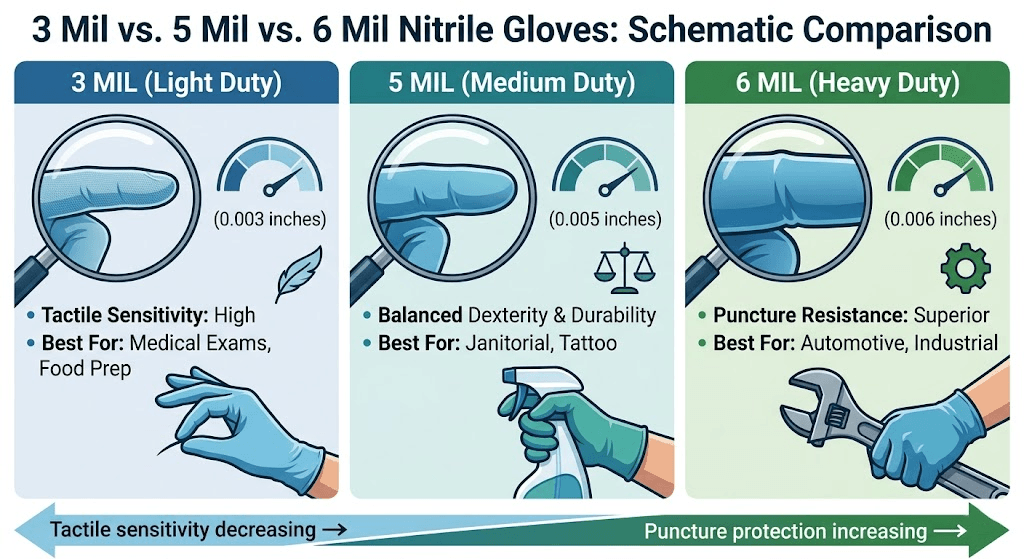
3 Mil vs. 4 Mil: Light Duty & Clinical Care
These are the “workhorses” of the medical examination room.
-
Best For: Routine check-ups, dental work, and high-volume food service.
-
Advantage: Highest dexterity and lowest cost-per-unit.
Nitrile Gloves Food Safe: Why 3 Mil is Ideal for Food Standards Agency Compliance
For the culinary and food processing sectors, ensuring your inventory is designated as nitrile gloves food safe is non-negotiable. A 3 mil thickness provides the unparalleled tactile sensitivity needed for intricate food preparation while maintaining a strict, non-porous barrier to prevent cross-contamination, aligning perfectly with strict Food Standards Agency regulations and hygiene protocols.
5 Mil vs. 6 Mil: The Versatile Middle Ground
This is the most popular range for general industrial and specialized medical use.
-
Best For: Janitorial work, tattoo artistry, and non-surgical clinical procedures.
-
Difference: A 5 mil glove offers moderate protection, while a 6 mil glove provides significantly more resistance to oils and mild cleaning chemicals.
8 Mil: Heavy-Duty Industrial Needs
When the environment involves automotive repair, heavy machinery, or prolonged chemical handling, 8 mil is the standard.
-
Best For: Mechanics, chemical processing, and emergency first responders.
Heavy-Duty Black Nitrile Gloves: Superior Protection for Mechanics and Industrial Safety
In heavy industry, thickness is the ultimate line of defense. Black nitrile gloves in the 6-8 mil range are specifically engineered to mask grease and oil stains while providing unmatched tensile strength. Integrating these heavy-duty options into your factory’s safety operating procedures ensures workers are protected against harsh chemical solvents and physical punctures without compromising their grip during high-torque tasks.
Nitrile Glove Thickness Chart: Industry Comparison
| Industry | Recommended Mil | Priority & Chemical Resistance |
| Medical Exams | 3 – 4 Mil | Dexterity & Biological Barrier |
| Food Handling | 3 Mil | Hygiene, Food Safe, Mild Oil Resistance |
| Janitorial / Cleaning | 5 – 6 Mil | Resistance to Bleach & Cleaning Solvents |
| Automotive / Mechanical | 6 – 8 Mil | Puncture Resistance, Oils & Grease |
| Chemical Labs | 5 – 8 Mil* | High Barrier Integrity for Reagents |
Note: Always check the specific chemical permeation breakthrough time for your reagents.
How to Use a Glove Size Chart to Ensure Maximum Personal Protective Equipment Efficiency
Thickness doesn’t matter if the fit is wrong. Utilizing an accurate glove size chart is critical for maximizing your personal protective equipment efficiency and ensuring the longevity of your PPE equipment.
The Physics of Stretching: If a glove is too tight, it will overstretch. This forces the molecular structure to expand, meaning a 6-mil glove might thin out to 3-mil at stress points (like the knuckles). This significantly degrades the barrier integrity, increases the failure rate of your PPE equipment, and leads to a mil failure where the glove rips unexpectedly.
-
Measure Correctly: Wrap a tape measure around the widest part of your palm (excluding the thumb).
-
Standard Sizing:
-
7 to 8 inches = Small/Medium
-
9 to 10 inches = Large/XL
-
Correct Donning & Doffing: A Critical Safety Operating Procedure
Even an 8-mil glove fails if self-contamination occurs during removal. Follow these steps for maximum biohazard safety:
-
Check for Defects: Before donning, inflate the glove slightly to check for pinholes.
-
Avoid Jewelry: Sharp rings can turn a 6-mil protection into zero-mil safety instantly.
-
The “Glove-to-Glove, Skin-to-Skin” Rule: Always peel the first glove off using the other gloved hand, then slide your clean finger under the remaining cuff.
💡 Expert Safety Tip: Maintaining a high-level Safety Operating Procedure requires more than just high-quality gear; it requires flawless execution.
Master the Full PPE Sequence: Download Our Gowning & Doffing Guide → Learn the exact order to put on and take off full protective equipment to eliminate cross-contamination risks.
Safety Standards & Compliance
Before finalizing your PPE supplies purchase, ensure they meet the following global benchmarks:
-
ASTM D6319: Standard specification for nitrile exam gloves for medical application.
-
FDA 510(k): Critical clearance for gloves used in clinical medical examinations.
-
EN 374: The strict European standard for chemical and micro-organism protection.
Beyond Hand Protection: Integrating Respiratory Protective Equipment into Your Safety Standards
Comprehensive risk management requires looking beyond hand protection. In environments requiring 6-8 mil gloves for chemical exposure or biological hazards, airborne risks are often equally severe.
Aligning your safety standards to include high-grade respiratory protective equipment (such as N95 respirators or PAPRs) alongside your hand protection ensures full-body compliance. As a leading provider of PPE supplies, Medtecs recommends a holistic approach to workplace safety, ensuring that every piece of gear—from gloves to masks—works in harmony to protect your workforce.
Conclusion: Choosing the Right Shield
Selecting the right nitrile glove thickness is a balance between protection and performance. While 3 mil gloves offer the best sensitivity for medical professionals, 6 mil and 8 mil versions provide the rugged durability required for industrial safety.
FAQ Section
- Q: Is a 4 mil nitrile glove thick enough for medical use?
Yes, 4 mil meets ASTM D6319 standards for examination grade, balancing tactile feel with pathogen protection.
-
Q: What is the shelf life of nitrile gloves?
Generally 5 years when stored in a cool, dark place, which is superior to latex’s 3-year lifespan.
-
Q: Can I reuse 6 mil nitrile gloves?
No. Regardless of thickness, disposable gloves are single-use PPE equipment to prevent cross-contamination.
References
-
ASTM International. (n.d.). ASTM D6319: Standard Specification for Nitrile Examination Gloves for Medical Application.
-
U.S. Food and Drug Administration (FDA). (n.d.). Medical Gloves Guidance and 510(k) Clearances.
-
Centers for Disease Control and Prevention (CDC) / NIOSH. (n.d.). Latex Allergy: A Prevention Guide.
-
Centers for Disease Control and Prevention (CDC). (n.d.). Sequence for Donning and Doffing Personal Protective Equipment (PPE).
-
Food Standards Agency (FSA). (n.d.). Personal Hygiene and Food Safety Guidelines.
-
Occupational Safety and Health Administration (OSHA). (n.d.). Personal Protective Equipment (PPE) Standards (29 CFR 1910.138).
-
European Standards (EN). (n.d.). EN ISO 374: Protective gloves against dangerous chemicals and micro-organisms.


